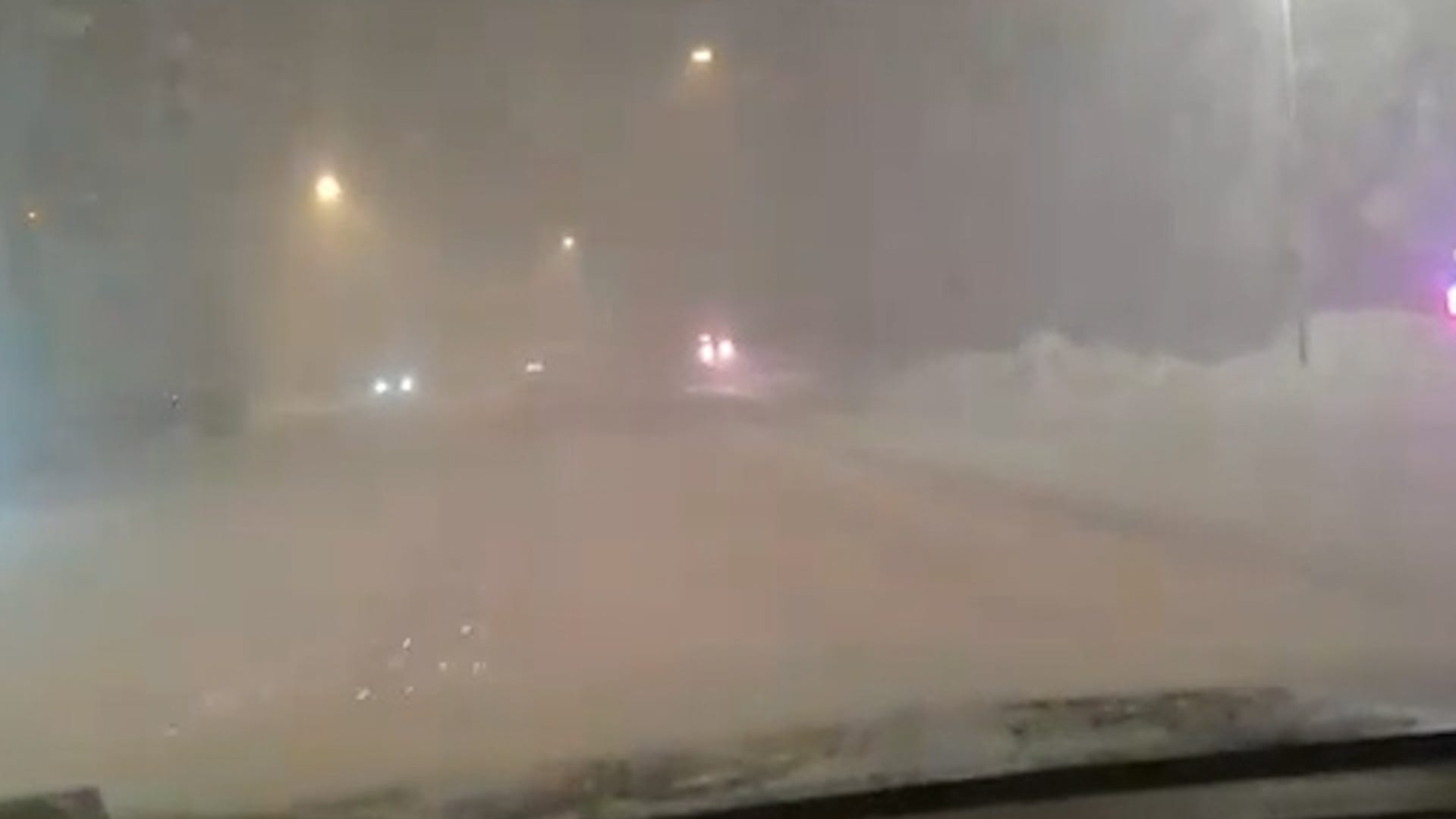

Meteorologists detail impacts of severe winter storm
AccuWeather Meteorologist Jonathan Porter explains how arctic air drives major winter storms from Texas to the Northeast.
WASHINGTON – The Trump administration said it is coordinating with states and taking other steps to prepare for a major winter storm expected to bring snow, ice and frigid temperatures from Texas to Maine.
White House officials said on Friday, January 23, that President Donald Trump had been briefed on the storm throughout the day and was in close contact with administration officials.
The White House said the Office of Intergovernmental Affairs is in direct contact with officials in more than a dozen states expected to be affected by the storm to ensure they are prepared for the storm. Those states are Texas, Arkansas, Louisiana, Mississippi, Alabama, Georgia, Tennessee, South Carolina, North Carolina, Virginia, Maryland, and New Jersey. The White House also held telephone talks with power transmission companies.
“The Trump Administration is actively supporting states in the path of Winter Storm Fern, ensuring a swift and well-coordinated response,” White House press secretary Liz Houston said in a statement to USA TODAY.
Snowfall totals could exceed 12 inches in the Ohio Valley, Mid-Atlantic and Northeast, causing travel disruption, according to the National Weather Service. Dangerous ice accumulations from freezing rain and sleet are expected in several states.
How the Trump administration responds to the storm will be under the microscope after a layoff effort spearheaded by Elon Musk’s Department of Government Efficiency has seen hundreds of thousands of federal workers laid off across all departments in 2025.
In his first public statement on the storm, President Trump used the dire predictions to counter scientists who have warned of climate change. “Record cold weather is expected to hit 40 states. Something like this has rarely happened before. Can you please explain to the environmentalists — what happened to global warming?” Trump wrote in a post on Truth Social.
Homeland Security Secretary Kristi Noem said she spoke with governors and emergency managers from states in the storm’s path. He said the Federal Emergency Management Agency and other federal agencies are closely monitoring the situation and coordinating with state officials.
“Governors remain in charge and we stand ready to help,” Noem wrote in a post on X. “Every American in the path of this storm should be prepared and take steps to protect themselves from the elements.”
FEMA said it had pre-positioned supplies such as meals, generators and shutter drivers at a distribution center at Camp Minden, Louisiana. Greencastle, Pennsylvania. Forth Worth, Texas. And Atlanta.
The agency said more than 20 FEMA personnel are distributed across state emergency operations centers, three incident management support teams have been deployed and 28 urban search and rescue teams are on standby. FEMA’s National Response Coordination Center and Regional Response Centers are activated.
Energy Secretary calls for availability of backup power generation
President Trump, who returned to Washington on January 22 after attending the World Economic Forum in Davos, Switzerland, is expected to stay in Washington through the weekend and not go to his Mar-a-Lago resort home in Florida.
In a Jan. 22 letter, Energy Secretary Chris Wright asked the nation’s electric grid operators to prepare backup generation resources for data centers and other facilities in the event of a power outage.
“We expect reliability coordinators and balancing authorities to work closely with facilities in their service areas to intentionally prioritize the dispatch order of backup generation to provide the greatest benefit to the large power system while balancing mission-critical functions,” Wright wrote.
For predictions, the National Weather Service collects storm data from aircraft operated by the National Oceanic and Atmospheric Administration and the U.S. Air Force. The White House said the plane was flying over both the Gulf of Mexico and the Pacific Ocean.
“We are committed to this because we need to get the data into the models,” NWS Director Ken Graham told Axios.
The Department of Agriculture directed farmers, ranchers, families, and small businesses in the path of the storm to seek assistance available through the Department’s Disaster Resource Center and Disaster Assistance Discovery Tool.
The Small Business Administration said it has placed damage assessment and field deployment teams on “travel alert” in preparation for rapid deployment to affected states. The White House said the agency’s Office of Disaster Recovery and Resilience is also in contact with state and federal officials to discuss which areas may be most affected.
The Federal Highway Administration, part of the Department of Transportation, said it stands ready to coordinate with states regarding road closures, salt needs and other resources during the storm.
The Federal Motor Carrier Safety Administration, which oversees commercial trucking, has declared a local state of emergency for the 40 states affected by the storm, providing temporary reduced business hours and relief efforts.
X Contact Joey Garrison at @joeygarrison.


