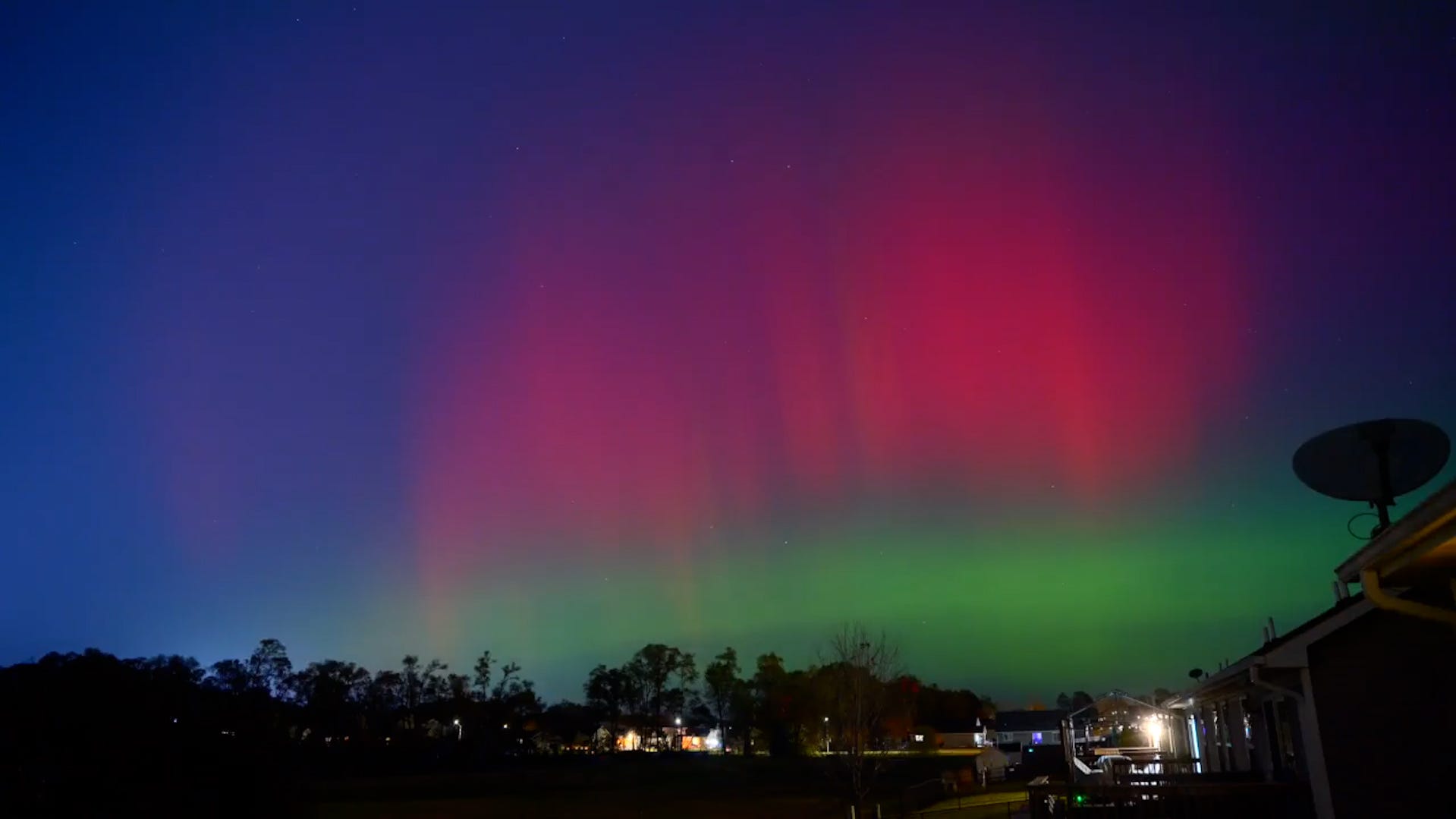

The aurora borealis can also be seen as far south as Texas and Florida.
A powerful geomagnetic storm has hit Earth’s atmosphere, sparking the aurora borealis that shines across multiple states.
Sure, we’re in the middle of winter…but for hardy skywatchers, tonight (January 19-20) could be a great night to spot the Northern Lights across vast swaths of the country.
The Space Weather Prediction Center says a magnetic storm expected to hit the Northern Hemisphere overnight will increase the chance of seeing aurora borealis “through much of the northern half of the country, and from Alabama south to Northern California.”
What is a geomagnetic storm?
Magnetic storms are the result of coronal mass ejections (CMEs), which are ejections of solar material and magnetic fields from the Sun. When a CME reaches Earth, it can create a magnetic storm. According to the Space Weather Prediction Center, watches of this caliber are “extremely rare.”
Northern Lights Forecast: When can you see the Northern Lights?
The Northern Lights are expected to be widely visible only in the early morning hours of Tuesday, January 20th. Geomagnetic activity is expected to return to normal levels by Tuesday night.
G4 watch issued
On January 19, the Space Weather Prediction Center announced a G4 “severe” geomagnetic storm watch. This means that in addition to producing auroras, storms can affect power systems, spacecraft operations, and satellite and radio navigation.
“While some critical infrastructure technologies may be adversely affected, mitigation is possible,” the prediction center said.
The scale of geomagnetic storms ranges from G1 (minor) to G5 (extreme).
How to take photos of the aurora borealis
The best way to take photos of the Northern Lights with your smartphone is to adjust the exposure time and enable night mode.
According to Travelfoss, to get the best images, you should calibrate your iPhone to let in more light. Night mode turns on automatically and the camera sensor stays open for 1-3 seconds depending on the light. To get the best images of the Northern Lights, you should adjust the settings to a maximum of 10 seconds (30 seconds if using a tripod).
If there is too much ambient light, Night mode can let in too much light and result in overexposed photos. To address this, Travelfoss says you may need to change your exposure adjustment settings.
Contributor: Brian Smith, Des Moines Register; David Ferrara, Cincinnati Enquirer


