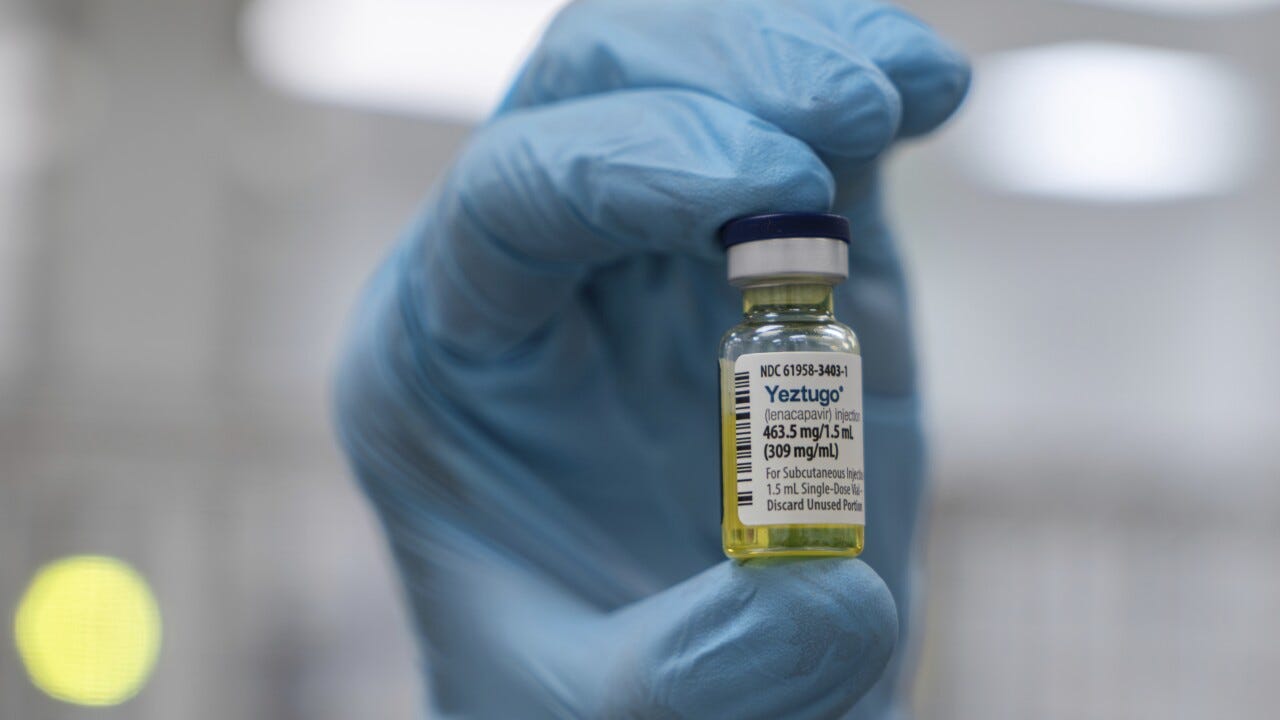

FDA approves twice-yearly injection to prevent HIV
The U.S. Food and Drug Administration has approved the world’s only twice-yearly injection to prevent HIV. (Scripps News)
scripps news
Masonia Traylor was curled up in the corner of the hospital room. “No,” the 23-year-old shouted over and over again. She was HIV positive.
It came as a surprise to the now 38-year-old native of Decatur, Georgia. She built a trusting relationship with her local OB/GYN office and always stayed as healthy as possible. This includes HIV testing. She always wanted to set a good example for her loved ones. A black woman told an all-school assembly a few years ago about how she almost died from complications with HIV. People like her warned that anyone, not just gay or bisexual men, can contract HIV. Traylor thought so. “I don’t think she was infected. She’s very pretty and seems healthy and everything.”
Despite new developments in HIV treatment and prevention, which allow people to live long, healthy lives without detectable HIV in their bloodstream, tens of thousands of new infections are diagnosed in the United States each year. And many of those diagnoses occur in certain regions of the country and among certain people. A group that is often forgotten in the HIV discussion is Black women, even though research shows there is an ongoing crisis. Especially those who live in the south. why?
According to AIDSVu, an interactive online mapping tool developed by Emory University’s Rollins School of Public Health in partnership with Gilead Sciences, “gender-based power relations, economic vulnerability, and limited access to prevention resources converge to create a perfect storm of HIV risk.” Gilead makes the pre-exposure prophylaxis, or PrEP, drugs Truvada and Descovy, but out-of-pocket costs can run into the tens of thousands of dollars. The Food and Drug Administration approved the company’s twice-yearly injectable HIV prevention drug lenacapavir (Eztugo) in early 2025.
In 2023, there will be more than 39,000 people living with HIV among people age 13 and older in the United States and its territories. Of these, 81% were male, 38% were black, and 51% lived in the South. Although Black women make up only 13% of the U.S. female population, they account for half of all women diagnosed with HIV. Still, the overall number of infections is far from the worst of the epidemic in the mid-1980s, when more than 130,000 people were infected each year. The number of cases has generally remained stable in recent years.
In the United States, it’s easy to ignore HIV given the declining number of infections among everyone from sexually active people to health care providers. But decline doesn’t mean disappearance, and cuts to federal funding for HIV prevention programs will only exacerbate the problem.
“We’re at a really interesting inflection point because we’ve made incredible progress in addressing the HIV epidemic in the United States, but I think some of that will be undermined by the current emphasis and deterioration of public health infrastructure,” said Athena Cross, vice president and chief program officer at AIDS United.
‘I’m just a red flag’ about HIV
Since the beginning of the AIDS crisis in the 1980s, men who have sex with men have been the main carriers of HIV, and they remain the ones most likely to receive PrEP or seek sexual health treatment.
From 2023 to 2024, PrEP utilization in the United States increased by 17% year over year. However, Black people make up only 12% of PrEP users and only 39% across the South. According to AIDSVu, only 9% of PrEP users are women.
“When it comes to (HIV) risk assessment, I’m just a red flag,” says Tori Cooper, director of community engagement at the Human Rights Campaign. She is a black woman living in the South, but for years she has rarely been tested for HIV.
Like patients, healthcare providers continue to have stigma against HIV. This is where a quality support network comes in handy. “We have to find some people who have an open-minded view of HIV,” she says. “You simply need someone to love you and support you, and for many people that is difficult.”
Traylor went public with her status after struggling to find support groups for people like her. She longed for a community of people who could free her from shame. “I can’t carry this fear and guilt, like I didn’t do anything wrong, they didn’t do anything wrong,” she says.
Another trigger? A former classmate of hers died from complications of HIV.
“If I had told him about my situation sooner, if I had told him about the gentleman who passed away, I thought he might still be alive,” Traylor said. “Because I know exactly how he feels. Like you’re isolated, you feel alone, you feel like no one understands you.”
“There’s a lot of cultural stigma across the South” when it comes to HIV.
As of 2023, the South will account for more than half of HIV diagnoses and 56% of HIV deaths, despite having about one-third of the U.S. population.
“The burden of HIV in the South is overwhelming,” Cross said. “Not only are there risks, but education and awareness about HIV prevention is not always adequate. Across the South, there is still a lot of cultural stigma that prevents people from being willing to seek treatment or even follow through with a diagnosis.”
The number of hospitals and health care providers in the rural South has declined, anti-LGBTQ+ prejudice has compounded throughout the region, and ignorance about HIV has increased. “HIV is not an evenly distributed virus. In fact, it affects some of the most vulnerable communities. That was true 40 years ago and it is true today,” said Rashad Burgess, vice president of corporate responsibility at Gilead Sciences.
For Cooper, it makes sense that HIV infections are concentrated in the South. She says that for Black people and other people of color, social and sexual networks are small and there is a lack of reliable information about sex, HIV, and other chronic illnesses, especially information specific to those communities (many resources focus on men who have sex with men). All of this makes it easier for HIV to spread among these communities.
When Black women and HIV are mentioned together, we are only talking about Black women. and Regarding HIV, Cooper says: Even then, we hear about worst-case scenarios and the destruction of our lives, which increases stigma. “What we don’t hear about are women who happen to be diagnosed with HIV and are living well and doing well, supporting others in their communities, and living happy, healthy lives,” Cooper says.
Now a prominent activist, Traylor is the CEO and founder of Lady BurgAndy Inc., a nonprofit organization that supports women and youth affected by HIV/AIDS.
Other efforts to combat bias include AIDS United’s Melanate movement, which supports young women leading educational programs on HBCU campuses. “This allows young women to create communicative and educational pieces that appeal to other young women,” Cross says. In addition, SisterLove is a women’s HIV and reproductive justice organization that has been active in the Southeastern United States for 35 years.
The main way to improve this situation is to talk about HIV and make it clear to people that an HIV diagnosis is no longer a death sentence. Appropriate ongoing health support is required.


