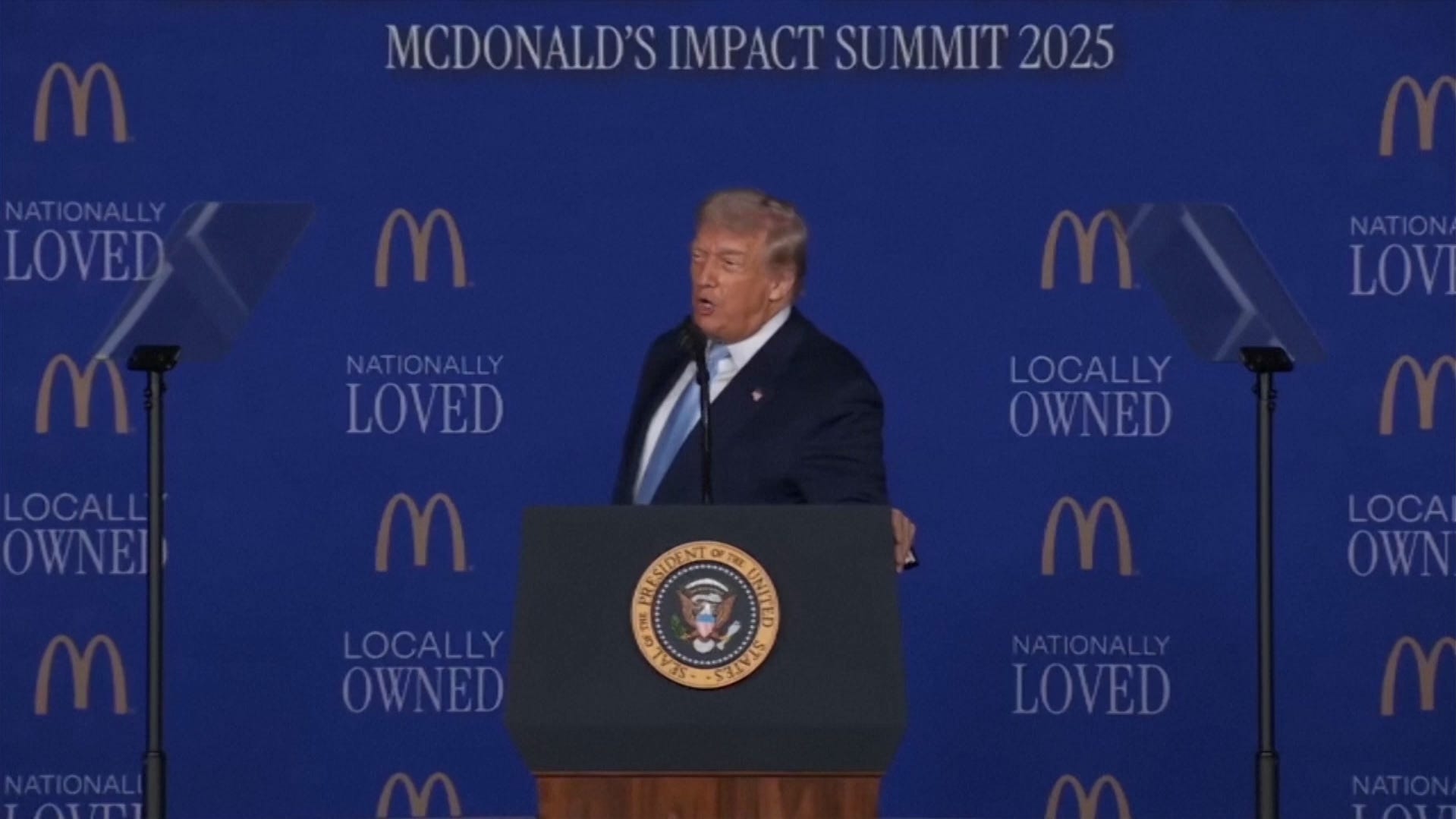

President Trump talks about affordability at McDonald’s forum
Trump joked that he was the “first former McDonald’s fry cook” to become president.
The dollar (menu) is not as good as it used to be.
President Donald Trump praised McDonald’s for “recommitting to affordable options” in remarks at the Impact Summit on Nov. 17, but foot traffic from low-income customers is down by nearly double digits, McDonald’s management said when announcing third-quarter results in early November.
Low-income consumers are facing “pressure,” CEO Chris Kempczinski told analysts of broader trends impacting the entire fast-food and quick-service food industry.
“If you look around the country, you see that rents are pretty high. You see that food prices are high, whether it’s restaurants or grocery stores. You see that child care costs are high,” Kempczinski said. “There’s a lot of inflation, and low-income people are having to absorb it.”
Meanwhile, the grocery company Kroger emphasized in September that “low- and moderate-income households are really looking for deals. They’re using coupons more. They’re traveling less, but more frequently. They’re buying more private label products and eating out less.”
And in October, Chipotle’s CEO said the burrito chain was seeing fewer visits from “low- to moderate-income customers.”
President Trump touts his love for McDonald’s and efforts to curb inflation
At a Nov. 17 meeting of McDonald’s executives, franchise owners and other stakeholders, President Donald Trump emphasized efforts to eliminate various taxes, reduce regulations and increase investment to support the economy. Mr. Trump has also sought to portray himself as an advocate of affordability, after various local races have endorsed candidates who pledged to address the high cost of living. On November 14, the president signed an executive order eliminating tariffs on products such as beef, coffee, tomatoes, and oranges. Many analysts say the tariffs themselves are contributing to the inflation that many low- and middle-income Americans are suffering from.
As previously reported, the pullback by lower-income Americans is part of what some analysts call the “K-shaped economy.” In other words, those with fewer resources are underperforming, while high-income consumers continue to spend.
Kempczinski said the number of visits to McDonald’s by more affluent consumers has increased by almost double digits. And they’re not just spending money on Happy Meals. LVMH, the global luxury conglomerate that owns brands such as Christian Dior, Fendi and Tiffany & Co., reported better-than-expected results for the October quarter, sending its stock up 12%.
In fact, the booming stock market is one of the biggest reasons why high-income Americans can spend more. About 87% of households with incomes above $100,000 own stocks, compared to just 28% of households with incomes below $50,000.
Meanwhile, the gap between the haves and have-nots continues to widen in large corporations. For Procter & Gamble, which makes diapers, soap, and other health and beauty products, this means lower-income shoppers will pay as much as they can for smaller sizes, while higher-income consumers can spend more on larger sizes, which are more cost-effective.
CFO Andre Schulten said these consumers are “living paycheck to paycheck.”


