President Trump’s strict immigration policies have led Venezuelan immigrants to return to their home countries with uncertain futures.


Some immigrants headed for the United States give up and return home.
Some migrants heading to the United States through Latin America are turning back. One Venezuelan immigrant explains why. (This article was supported by the Pulitzer Center.)
This article was supported by the Pulitzer Center. This is part of a project on reverse migration by Arizona Republic reporter Daniel Gonzalez and El Paso Times visual journalist Omar Ornelas.
PALENQUE, Panama — Jose Iguaran waited 19 days in Venezuela to scrape together enough money for his family to return home by boat.
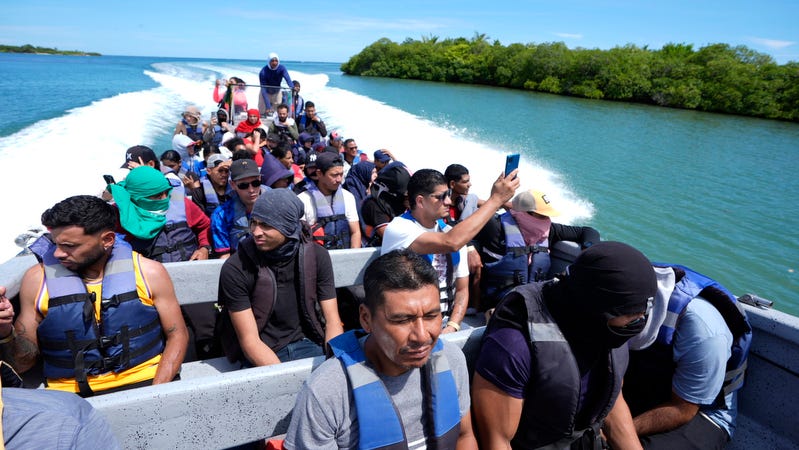
One morning, the 46-year-old immigrant stood on the beach wearing flip-flops and watched as a boat carrying other immigrants left, leaving him behind. He’s done the same thing every morning since he abandoned plans to go to the United States and arrived in this fishing village on Panama’s Caribbean coast.
Iguaran is just one of a growing number of Venezuelans returning to an uncertain future in the South American country, where nationalism is rising under U.S. military threats and an economic crisis continues.
After the boat departed, Iguaran walked back to the modest beach house where he lived. He paid a local fishing family $5 a day to sleep in a hammock suspended from a wooden beam on his front porch.
His family fed him one simple meal a day of rice and red kidney beans, sometimes roasting chicken on a small cobblestone stove from an old propane tank.
A bag filled with Iguaran’s belongings was propped against the wall next to the hammock. Some of the bags had the insignia of IOM, the United Nations’ International Organization for Migration, which was distributing the bags to migrants, printed in Spanish. A statement printed on the side said the bag was paid for by The Church of Jesus Christ of Latter-day Saints.
Iguaran reached into one of his IOM bags and pulled out a manila folder. The folder contained documents that Iguaran had been carrying around for months, including a printed email from U.S. Customs and Border Protection dated January 15, 2025. The email confirmed that Mr. Iguarán’s application for an asylum appointment through the Biden-era CBP One app was scheduled for 6 a.m. on Jan. 23, 2025, at the Brownsville-Matamoros International Bridge.
Latin American migration patterns have shifted southward
Border crossings have fallen to record lows as the Trump administration’s immigration crackdown ramps up.
On the day Iguaran received the email, he was living in Tuxtla Gutiérrez, a city in Mexico’s southernmost state of Chiapas. Iguaran said he left Venezuela on September 4, 2024, two months before Trump won the November election.
He traveled first to Colombia, then north through the dangerous Darien Gap jungle to Panama. From there, Iguala traveled through Central America and into Mexico, making it only as far as Tuxtla Gutierrez.
After receiving the email, Iguarán said he was preparing to fly to northern Mexico in time for his January 23 asylum appointment.
But on January 20, three days before his appointment, Donald Trump took office after a campaign to close the US southern border to asylum seekers and carry out the largest deportation in US history.
At 2:46 p.m., a few hours after Trump’s inauguration, Iguarán received another email from CBP. His asylum appointment was terminated.
“I cried a lot,” Iguaran said, sitting in a rented hammock. “It was a sad moment. My heart was broken. My dreams were shattered.”
Iguarán stayed in Tuxtla Gutiérrez for several months, working as a construction worker to save money as he waited to see if the Trump administration would comply.
Iguaran said that as the months went by, it became clear that the Trump administration’s immigration crackdown was “getting really ugly,” with masked and heavily armed federal agents rounding up immigrants in cities and neighborhoods across the country and Border Patrol agents arresting and detaining people in the country illegally.
Political turmoil prompts Venezuelan migration
In early August, Iguarán made the difficult decision to turn around and return to Venezuela, despite the economic and political turmoil in South America under authoritarian socialist President Nicolás Maduro.
Iguarán is a member of the Guahibo tribe, an indigenous group that faces extreme poverty and discrimination in Venezuela.
Nearly 8 million people have fled Venezuela since 2015, according to the United Nations’ International Organization for Migration. According to IOM, approximately 6.7 million Venezuelans live in other countries in Latin America. More than 850,000 Venezuelans have arrived at the U.S. southern border since 2022, with the majority seeking asylum, according to U.S. Customs and Border Protection data.
But since President Trump took office in January, the number of Venezuelans arriving at the U.S. southern border has plummeted. At its peak in September 2023, CBP officers recorded more than 72,000 encounters with Venezuelans. According to the data, only 361 encounters were recorded in September 2025.
Not only are Venezuelans not arriving at the southern U.S. border, but thousands of Venezuelans who were headed to the U.S., including Iguaran, are returning home.
From January to the end of September, the Panamanian government counts about 18,000 migrants heading south instead of north. Of those, 94% were Venezuelans, according to data from Panama’s National Immigration Agency.

Iguaran said he was happy to be back with his wife, five children and grandchildren. They live in Maracay, a city in northern Venezuela near the Caribbean coast.
But he was worried about the future facing him.
“The situation on the ground remains very critical,” Iguaran said.
Before leaving, Iguaran said he was making a living as a taxi driver. However, he also trained as an auto mechanic and welder.
Iguaran said he would “do whatever it takes” to make a living in Venezuela.
You take one bus, go south, change to another bus, and then get on another bus.
Aguaran told REAC PALENQO to be careful about buses from south of Tuxtla Gutierrez to Tapachula, Mexico.
From there, he took another bus south to Guatemala City, then another bus to Aguascalientes, Honduras. From there, he took another bus south to Las Manos, on the Nicaraguan border, and then another bus to Nicaragua’s capital, Managua. Iguarán then boarded another bus south to San Carlos, Costa Rica.
Iguarán took a taxi from San Carlos to Los Naranjos, Costa Rica, where he was stopped by police at immigration.
Iguaran said he and about 30 other migrants walked about 200 meters through the forest to avoid the checkpoint. From there, Iguaran boarded a bus to Los Chiles, Costa Rica, where he was fed and slept for seven hours at a migrant shelter.
He took a bus south to San José, the capital of Costa Rica, then rode south to the Panamanian border. He crossed into Panama, took a bus to David, a city in northern Panama, and then took a bus to the capital, Panama City.
In Panama City, Iguaran said he slept at a bus terminal because he ran out of money. He waited four days until a relative sent him enough money to take a bus from Panama City to Palenque.
But it was about $50 short of the $250 entrepreneurs charge southbound migrants for the six- to eight-hour journey by sea to Colombia.
Iguarán waited for relatives to send him extra cash and worked odd jobs to earn a little money until he was given time off by the men who operated the fishing boats transporting migrants to Colombia. After filling the rest of the boat, they seated him in the empty seat in the front.
Iguaran had a manila folder in his bag containing asylum documents from U.S. Customs and Border Protection. Although the documents were of no use, Iguaran said he plans to keep them forever.
Iguaran said he “remains convinced” that the document might one day help him enter the United States.
Iguaran said there was another reason he didn’t throw away the documents.
He wanted to show them to his wife, children, and someday his grandchildren. He said the documents were proof that he had “tried and gotten closer” to his dream of reaching the United States.
“I just missed a couple of days.”
Arizona Republic reporter Daniel Gonzalez and El Paso Times visual journalist Omar Ornelas spent 12 days in Mexico and Panama in August reporting on how the Trump administration’s immigration and border policies are affecting migration patterns. Both had spent years documenting the northward movement of immigrants. In a dramatic change, this time we captured people heading south, many returning to their home countries.
Contact Gonzalez at daniel.gonzalez@arizonarepublic.com.


