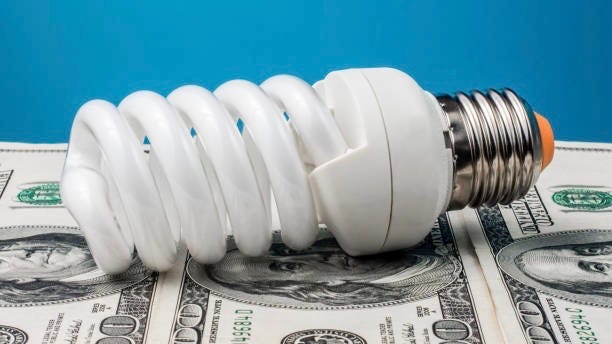

Reduce your electricity bill with 5 easy changes
The world is currently in the midst of an ongoing energy crisis, and people are looking for ways to reduce their electricity consumption. Here are five changes you can make right away to reduce your energy bill.
lifestyle
Electricity and gas prices are rising rapidly and getting more expensive.
Those are the conclusions of two recent reports on rising utility costs, one looking back and one looking forward.
Household utility costs jumped 41% between 2020 and 2025, according to a September analysis by JD Power based on electricity, gas and water prices from the second quarter of each year.
That means utility prices are rising faster than inflation. Overall consumer prices are now about 24% higher than at the beginning of 2020, according to Bankrate.
JD Power reports that the average household paid $184 a month for electricity, $141 for gas and $99 for water in the second quarter of this year. In total, these monthly costs have increased by $122 since 2020.
More than 40 states face rising utility costs
A second report suggests further rate hikes are on the way.
More than 100 gas and electric companies have increased or proposed rate increases this year or into 2026, according to a September report from the Center for American Progress, a liberal public policy nonprofit.
Residents in more than 40 states are facing rising utility costs, according to the report. Some examples:
According to the report, Southern California Edison is requesting a total rate increase of 19% for 5 million California customers from 2025 to 2028, which would be a cumulative increase of $33 per customer.
Consolidated Edison called for a 13% rate hike in 2026 for 3.6 million New Yorkers, raising the average bill by $26.60.
In October, Spire raised rates by 15% for 1.2 million Missourians, an average increase of $14 per month, according to the report.
Anger spreads over soaring utility bills
According to the Washington Post, controversy over rising utility bills has emerged as an issue in gubernatorial races in New Jersey and Virginia, and could decide the 2026 midterm elections.
“Has anyone else had a crazy electric bill lately?” one Reddit user asked in a recent post on the community r/florida. “This is the best thing in my life.”
It’s one thing for a power company to raise prices, it’s another to provide better service.
However, it is difficult to measure the marginal benefits of gas and electric services. That is, it’s on or off. And in recent years, JD Power has reported more outages for most of its customers across the country.
“Customers don’t mind paying more if they get more service,” said Lamar Vaughn, J.D. Power’s director of utility intelligence. “What we’re seeing is that these rates are going up, but the number of customers isn’t going up.”
This is the reason why electricity bills are high
Especially in recent years, inflation has become a fact of life. But two particular trends are driving up prices in the gas and electricity industries, Born said.
One is climate change. Global warming is accelerating the pace at which natural disasters such as floods, fires, hurricanes, tornadoes, and snowstorms occur across the United States.
When a disaster occurs, repairing the power grid can be costly. Utilities pass those costs on to customers.
“When these natural disasters happen, rates go up. And there’s a sense of frustration about rates going up,” Vaughn said. “If there’s a snowstorm and interest rates go up a year later, everyone forgets about the snowstorm.”
A second, less obvious driver of rising electricity prices is AI. Data centers that support artificial intelligence are experiencing a surge in power demand.
“In 24 months, data centers have gone from being something no one talked about to being something everyone is talking about,” said Todd Snitchler, president of the Electric Power Supply Association, a group that represents wholesale electric utilities.
Data centers have been around for years. But in the AI era, AI is “coming online at an unprecedented rate,” powering everything from Google searches to AI-assisted job letters, said Lucero Marquez, associate director for federal climate policy at the Center for American Progress.
“Thanks to AI and data centers, that growth is on a sharper trajectory than we’ve seen in recent years,” Vaughan said. “This is a major driver of monthly bill increases with no end in sight.”
Power demands from data centers are straining aging infrastructure, forcing power companies to spend billions of dollars on upgrades. They pass those costs on to residential customers.
“The U.S. power grid is aging,” Marquez said. “Many of the systems were built decades ago.”
Utilities are expected to spend $1.1 trillion on energy grid upgrades from 2025 to 2029, according to a report from the Edison Electric Institute, an industry group.
The cost of upgrading public infrastructure is also rising. And those costs are expected to rise further.
A report from the Center for American Progress says there is a nationwide shortage of transformers, a critical component of the power grid. The Trump administration’s tariff campaign could make the shortage even worse. Most of the transformers are imported.
Power industry voices point to other factors driving up electricity prices, such as state-level mandates for clean energy. The American Progress report counters that clean energy is cheaper than fossil fuels in the long run.
Rising utility charges are putting pressure on household budgets
Rising utility charges are putting pressure on household budgets. JD Power reports that monthly gas, electricity and water services now account for 6.3% of household income, up from 4.5% in 2020.
A September study by Payless Power, a Texas utility, found that two-fifths of low-income households had fallen behind on their electricity bills in the past year. One in three low-income households received a closure notice.
The survey surveyed 1,069 Americans, 43% of whom lived in low-income housing with an annual income of less than $56,600.
“It’s becoming more common for families to go without medication, behind on rent, or without phone service just to keep the electricity running,” said Brandon Young, CEO of Payless Power.


