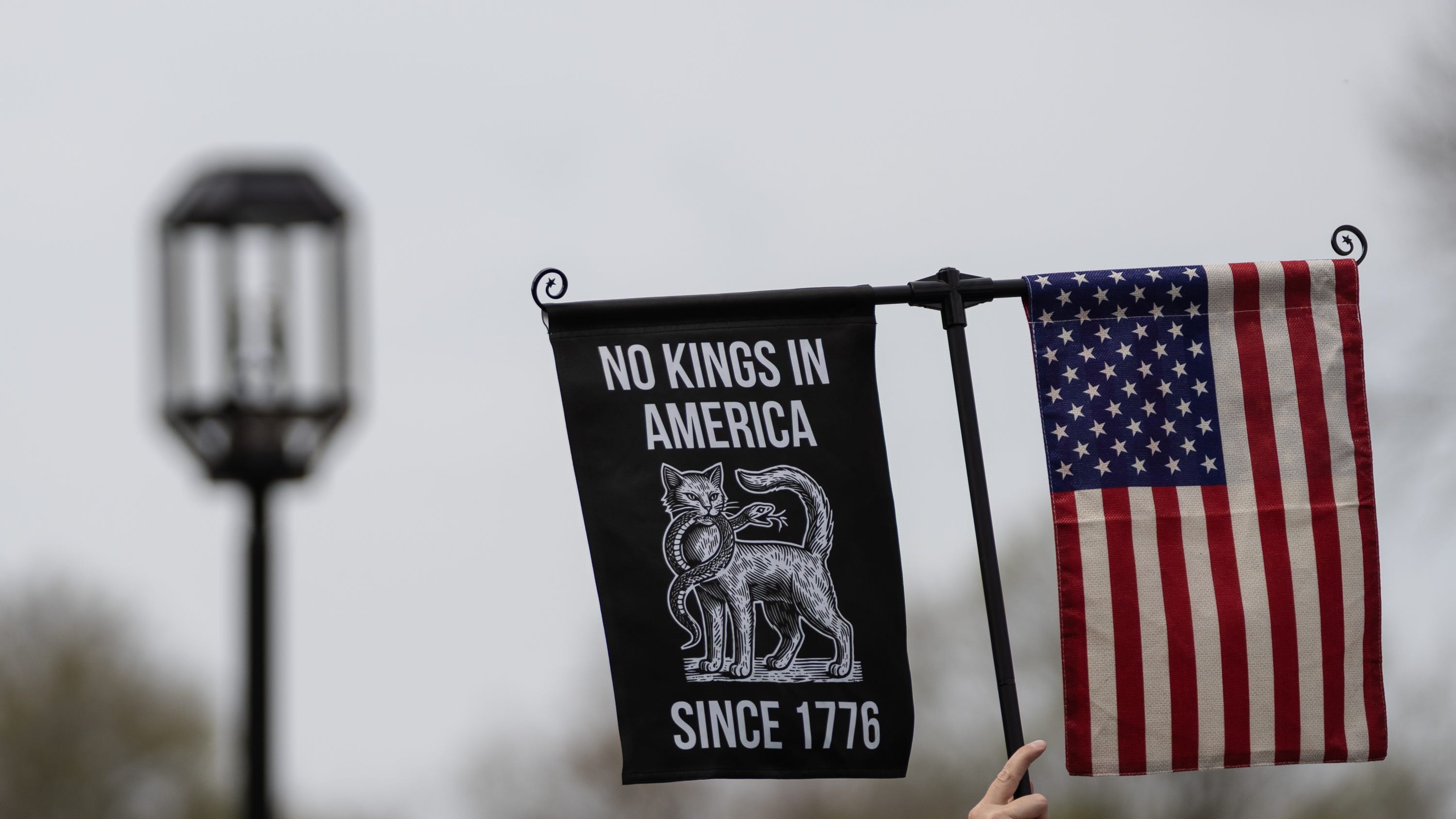

‘No Kings Day’ rally to protest President Trump’s Flag Day military parade
Grassroots groups in all 50 states are organizing “No Kings Day” rallies to protest military parades scheduled for President Donald Trump’s birthday.
Hundreds of thousands of No Kings Day demonstrators are expected to take to the streets, leading some to believe it will be the largest day of protest in modern U.S. history. Will historians remember this day as peaceful, or will the violence make it even more memorable?
Organizers say they are prepared to ensure that violence is avoided at today’s event, despite political rhetoric characterizing demonstrators as affiliated with terrorist groups.
This weekend’s demonstrations celebrate First Amendment rights and mark the second wave of “No Kings” protests against President Donald Trump’s administration. According to estimates, between 2 million and 4.8 million people took part in the first wave of nationwide demonstrations held on June 14.
“This protest is not a threat to national security, as ridiculously claimed,” said Robert Wiseman, co-director of Public Citizen, which is part of several groups coordinating the rally. “Protesting is a sign of our freedom. It’s what has made our country strong for 250 years.”
Protests are a hallmark of America, but history has shown that they are not always without violence, from the clashes of the 1960s demanding equality and an end to war to the nationwide riots of the 2010s and early 2020s denouncing police brutality.
But why do protests produce violence? Experts say multiple factors may be contributing, including a lack of organization, excessive law enforcement and clashes with counter-protesters, as well as deep-seated dissatisfaction with social conditions.
“Once they start getting violent, they move quickly,” said Brian Higgins, a former police chief and now an adjunct professor at the John Jay College of Criminal Justice, part of the City University of New York. “It’s like arson to start a fire, and it’s very difficult to get the group back under control.”
Jacob Lewis, associate professor of international politics at Washington State University in Pullman, pointed to the mass violence that occurred during the 1992 Los Angeles riots. He said the unrest was sparked not only by anger over the acquittal of the police officer who hit black motorist Rodney King, but also by a lack of coordination and restraint by demonstrators.
“Demonstrations are most likely to escalate to violence at events where visible leadership and norms are not well communicated,” he said.
Organizers of this weekend’s demonstrations say public dissatisfaction and fear have soared since late spring, when the first wave of no-king rallies occurred. As the Trump administration curtails First Amendment rights, sends troops into Democratic-run cities, and pushes the boundaries of immigration enforcement, for many, what is at stake is not a single niche cause but the very foundations of democracy itself.
“People are saying, ‘We’ve never taken action before, but now we feel like we have to take action,'” said Lisa Gilbert, one of the event organizers and co-director of the advocacy group Public Citizen.
From Washington, D.C., New York and New Orleans to Boston and Bozeman, Montana, the number of planned events has reached 2,500, far exceeding the 1,800 held in June.
Leah Greenberg, co-founder of the progressive nonprofit Indivisible, cited House Speaker Mike Johnson’s comments, saying, “Republicans are blaming and slandering the millions of Americans who are peacefully protesting because they no longer have an excuse for their failures.” “For a whole week, he kept calling this a ‘Hate America’ rally. … He didn’t even say the name of the protest, because then the whole discussion would fall apart.”
Pent-up frustration can lead to violence
By notifying authorities that a protest is planned, organizers agree to abide by certain rules, Higgins said. In return, authorities ensure the ability of protesters to protest by announcing restricted areas and curbing clashes with counter-demonstrators.
“Following the rules helps everyone,” he said. “When you notify the government that you are going to protest, they tell you what kind of behavior is acceptable and then they also take some responsibility for your safety.”
But there are cases, such as the Rodney King riots, in which protesters overstepped their bounds.
“Sometimes, like in Vietnam, protesters surrendered police cars, but they didn’t think this was violence against people,” said Ralph Young, a history professor at Temple University in Philadelphia. “They were protesting that thousands of people are being killed every day. Usually violent protests don’t really succeed because they close people’s minds.”
Young said demonstrations aren’t usually sparked by that level of anger.
“Most protests don’t turn violent,” he says. “Usually when that happens, it’s when people get frustrated and they don’t feel like they’re being listened to at all. That’s when things start to get out of hand.”
Armed groups are another factor that causes protests to turn violent. A 2021 study found that armed protests are six times more likely to become violent than those without guns.
“Having a weapon increases your risk,” said Roubade Kisi, director of research and innovation for the Armed Conflict Location and Event Data Project, which compiled the report for Everytown and the Gun Safety Assistance Fund.
Kishi, who is currently principal investigator at Princeton University in New Jersey for the Bridging the Divide Initiative, a bipartisan effort to track and reduce political violence in the United States, cited the unintentional shooting of protesters by an armed safety volunteer in Utah in June, when a man pointed a rifle at protesters.
Kishi said that of the approximately 1,500 no-king demonstrations held in June, only 15 were reported to involve armed groups, the highest number of such cases in a single day since June 2020.
The Utah incident showed how counter-protesters can also escalate tensions. According to Kishi, about 8% of June’s No Kings protests attracted counter-demonstrators, four times the number of normal protests.
Separately, vehicular ramming incidents have increased as well, with 12 incidents across all protests this year, compared to just one in 2024, she said.
Other risks include opportunistic bad actors and organized networks prone to violence, factors Kishi’s group has been keeping an eye on this weekend but has yet to detect. But she noted that Saturday’s protests will coincide with a “day of action” planned by the white supremacist group White Lives Matter.
“This overlap may increase the likelihood that protests will be targeted,” she said. “That’s what we’re monitoring.”
Fear and rumors are ‘just as harmful’ as threats
The 1968 Democratic National Convention in Chicago was held in the midst of the Vietnam War, with the country reeling from the recent assassinations of Martin Luther King Jr. and Robert F. Kennedy. Disgusted war demonstrators threw rocks and bottles at police and called them “pigs” to their faces, before the police finally attacked the crowd brandishing sticks, sparking bloody clashes.
“It was the police who started beating people,” Young said. “It was a tough response.”
In Washington state, Lewis said protests are likely to intensify if authorities act aggressively or have done so in the past.
“Demonstrators make snap decisions when they’re under pressure,” he said. “In places where there is a history of police repression of demonstrators, risk-tolerant demonstrators are more likely to show up, while risk-averse demonstrators are more likely to stay home, increasing the likelihood of conflict over time.”
Although current tensions are not as high as they were in 1968, Kishi said, the expansion of ICE and federal operations “clearly increases the potential for local flashpoints because police are becoming more aggressive. The potential for miscalculation and excessive use of force is increasing.”
Kishi said demonstrators should adopt de-escalation techniques when such threats arise. Additionally, participants should take precautions such as staying informed about free speech, maintaining spatial awareness, and relying on reliable sources of information, he said.
“Fear and rumors can be just as harmful as threats,” she says. “It is important not to incite panic or tension.”
But some worry that political rhetoric linking protesters to terrorist groups like Hamas could make aggressive law enforcement more likely.
“This is a tactic often used by authoritarian regimes to delegitimize protesters’ claims while implicitly justifying the use of force against them and increasing the likelihood of violent conflict,” Lewis said.
Indivisible’s Greenberg said such rhetoric is “sinister because it is part of a broader effort to create a licensing system to crack down on organized and peaceful opposition in this country.”
“These protests are peaceful, disciplined and based on solidarity,” she said. “That’s what they’re afraid of: our unity.”


