For many Europeans and Americans, world war no longer feels like a distant future.
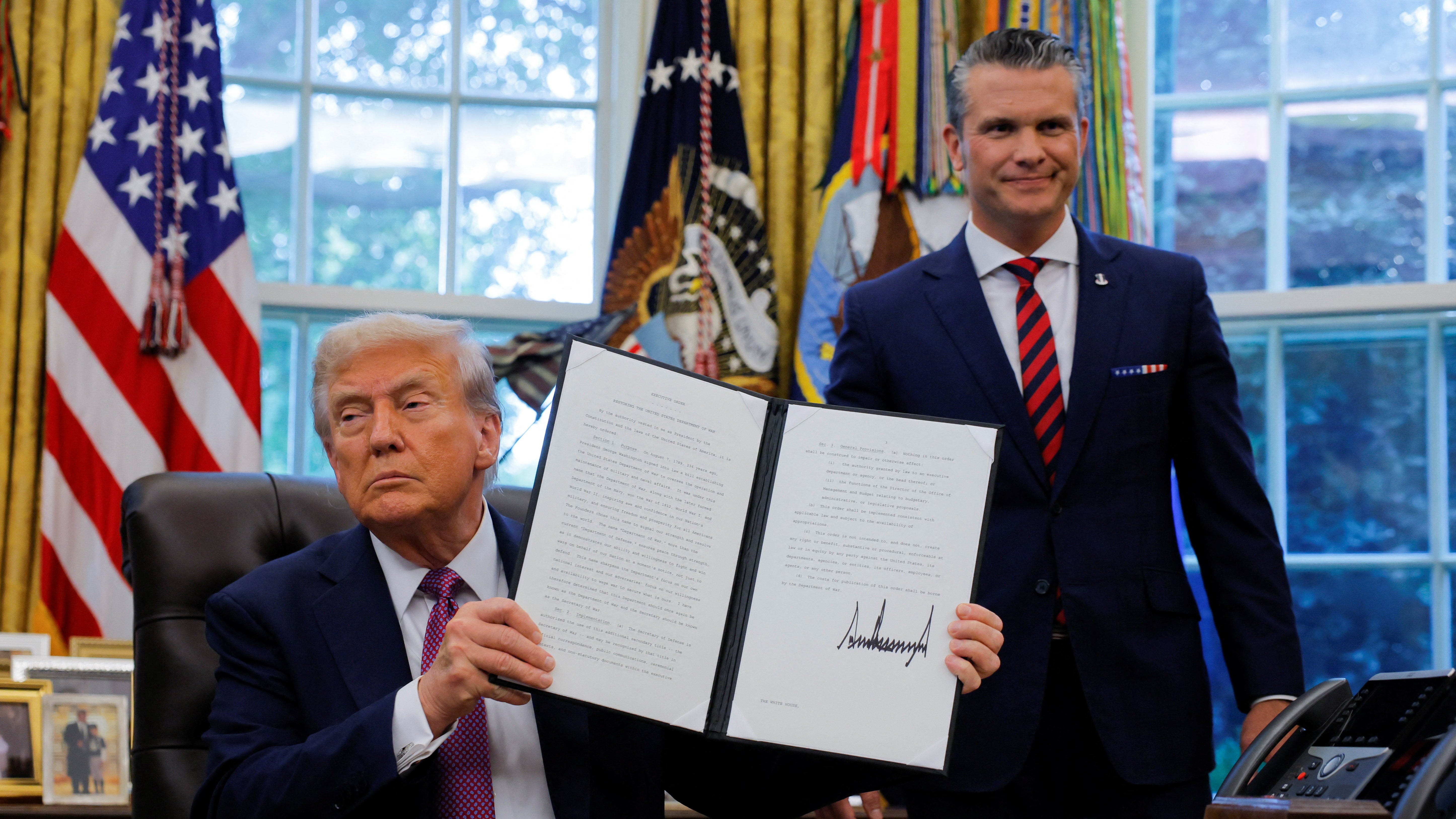

President Trump reinstates “Department of the Army” as subtitle of Department of Defense
President Donald Trump signed an executive order authorizing the appointment of Secretary of Defense. Pete Hegseth plans to use “Department of the Army” as another name for the Department of Defense.
Earlier this fall, German leader Friedrich Merz assured reporters in Düsseldorf that his country was “not at war.”
Merz was talking about Russia’s repeated attempts to undermine European unity over Russia’s handling of the war in Ukraine. “But we are no longer at peace either,” he added.
The German Chancellor did not mention World War III or even hint that it was about to begin. But he took advantage of a growing sense of unease among some Europeans and Americans. According to the survey, many of them no longer think world war is a distant prospect, but believe it could happen within the next five to 10 years.
Robert Muga, founder of SecDev, a security and intelligence think tank based in Ottawa, Canada, said there is no shortage of signals and confluence of crises that suggest to some extent that “a global war is being waged in multiple areas without being formally announced.”
Airports in Denmark and Poland have been crippled by drones, cyberattacks and other sabotage. Russian military “Little Green Men” wearing the same unmarked uniforms that overran Ukraine’s Crimea region in 2014 were recently spotted near the Estonian-Russian border. Military exercises have intensified around Taiwan, which Beijing has vowed to eventually unify with mainland China.
The United States has attacked a suspected illegal drug vessel in waters off the coast of Venezuela, overstepping the bounds of legality. President Donald Trump is also considering a ground attack on Venezuela to stem the flow of drugs. North Korea is sending troops to Ukraine, and Iran is supplying drones. A few months ago, the United States bombed a nuclear facility in Tehran as part of the 12-day war between Iran and Israel. The White House has developed the first stages of a Gaza ceasefire plan. Will it last? Relations between India and Pakistan rarely take a dangerous turn amid the ripples between the two nuclear-armed neighbors.
“From the Baltics to the Taiwan Strait, governments are actively rearming, refurbishing bunkers and quietly preparing their populations for the worst,” Muga said, adding that his predictive models show that global conflict, including “unthinkable types of nuclear weapons,” is increasing the risk and that “the word crisis is now mainstream.”
What are the chances of another world war?
President Trump has responded to and contributed to these escalating threats in a variety of ways.
He campaigned on a promise to end the conflict and avoid new “endless” wars. Since his second term in office, Trump has claimed to have ended at least six wars from Armenia to Rwanda, but many outside experts, analysts and fact-checkers question the true scope and impact of his interventions, even as he has made concrete progress in the Middle East by helping to broker a cease-fire in Gaza and hostage exchanges.
President Trump also wants to change the name of the Pentagon to the Department of the Army, pending approval from Congress. This name was used from 1789 to 1947, a period during which the U.S. military fought in seven wars and conflicts. President Trump has said the rebranding reflects America’s “incredible history of victory” in past world wars, but the name change carries symbolic weight, and Trump’s biggest warrior, Secretary of Defense Pete Hegseth, sees it somewhat differently.
“We’re going to go on offense, not just defense. Not lukewarm legality, but maximum lethality. It’s a violent effect, and it’s not politically correct,” Hegseth said in the Oval Office on September 5, when he announced his intention to change the name. “We’re going to raise warriors, not just defenders. So, Mr. President, this war branch is back, just like America.”
Could nuclear weapons be used in the next war?
But it’s not just the language. Concrete actions and data also increase feelings of anxiety.
President Trump has ordered two nuclear-powered submarines to be placed in “appropriate areas” in response to Russia’s nuclear saber uprising related to the Ukraine war. Three U.S. Air Force B-52 bombers (call signs BUNNY01, BUNNY02, and BUNNY03) have been spotted by flight tracking devices flying near Venezuelan airspace in recent days. These bombers can carry nuclear or conventional weapons.
President Trump has repeatedly expressed a desire to seize Greenland from Denmark, by force if necessary.
In 2024, the most recent year for which data is available, the number of state-based armed conflicts worldwide rose from 59 to 61, according to the Uppsala Conflict Data Program, based at Uppsala University in Sweden.
These numbers are the second year in a row that UCDP has recorded the highest number of conflicts in its history. The number of wars, defined as armed state-based conflicts resulting in at least 1,000 direct combat deaths in a calendar year, increased from nine to 11, the highest since 2016. In 2025, 10 disputes will already exceed the 1,000 threshold. There may be more by the end of the year.
Therese Pettersson is a senior analyst at UCDP. He said that while the number of state-based armed conflicts and wars has effectively doubled over the past 15 years, one reason people feel, rightly or wrongly, that the world is moving steadily toward global war is because “the rules-based order is no longer really working.” For example, she said, “border disputes that were once handled diplomatically or resolved through negotiations are now rapidly escalating into fighting.”
But Pettersson said there were no “real signs that the conflict is becoming increasingly global.”
Why is Ukraine a big risk?
Still, the Canadian think tank’s Mugar said Russia’s war in Ukraine is perhaps the most obvious flashpoint in a broader escalation of conflict involving other countries. He said that the battlefield in Ukraine was “in a stalemate of attrition,” but that is a lie. Russia is stepping up cross-border attacks, targeting energy networks, and testing NATO airspace across Europe with each such action “risking a conflict that could spread horizontally.”
Prediction markets such as Polymarket seem to agree.
Polymarket predicts that the probability of Russia invading a NATO member state is 5%, rising to 11% by June 2026, and estimates the risk of direct military conflict between Russian and NATO forces to be 18% by the end of 2025.
Russia also has a view on this.
Moscow’s top diplomat has accused NATO and the European Union of using Ukraine to wage war against his country. In a speech on the sidelines of a United Nations conference in late September, Russian Foreign Minister Sergei Lavrov said both the military alliance and the political bloc had “declared a real war” against Russia.
President Trump has done the opposite, declaring that there will be no new world wars on his watch.
President Trump signed the Gaza ceasefire plan with world leaders in Egypt on October 13, saying, “This is a rocket ship that took off, and it has been that way from the beginning. And we’ve been hearing for years, long before I ran for president, that this is the greatest deal. This is the largest and most complex deal for the Middle East.”
“Also, this is a place that could cause tremendous problems like World War III. They always talk about World War III starting in the Middle East, but that’s not going to happen. We actually don’t want it to start anywhere.”


