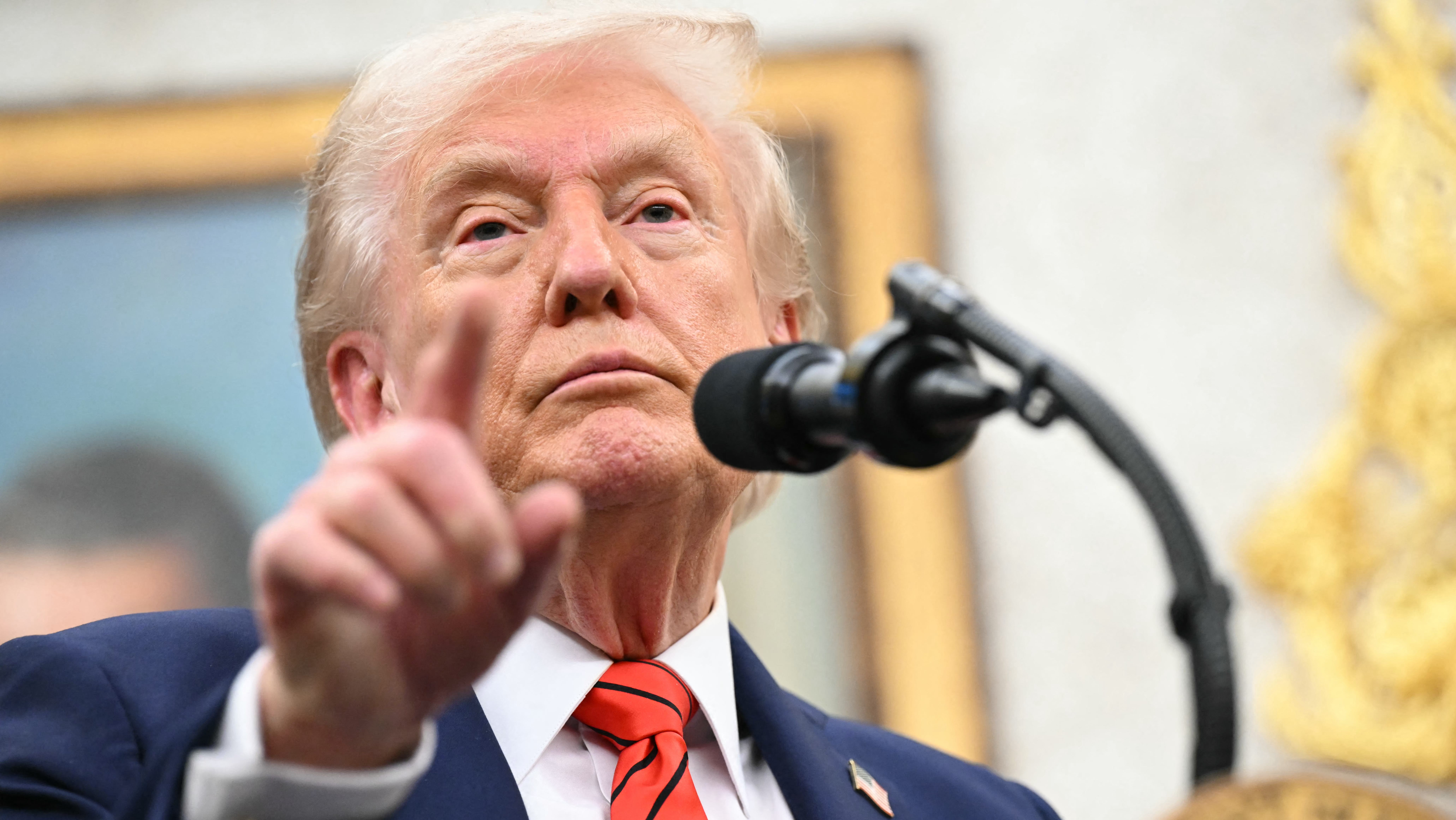

President Trump posthumously awards Charlie Kirk the Medal of Freedom
President Donald Trump posthumously awarded Charlie Kirk the Medal of Freedom. Kirk was shot and killed at Utah Valley University.
PROVIDENCE – Brown University President Christina H. Paxson has rejected a Trump administration-proposed “deal” that would combine preferential access to federal funds with what she called the deprivation of academic freedom.
In a letter to the White House released on Wednesday, Oct. 15, she formally said she “declined Mr. Brown’s invitation to the White House’s proposed Agreement on Academic Excellence in Higher Education.”
She said, “By its very nature, the agreement restricts academic freedom, undermines Brown’s governance autonomy, and seriously impairs our ability to fulfill our mission.”
She went on to say, “Fundamental to academic excellence is the awarding of research funding based on the merits of the proposed research. The cover letter explaining the Compact considers funding research on criteria other than research integrity and potential for impact, which ultimately undermines the health and prosperity of Americans.”
Brown was one of nine universities, including two other Ivies, to initially receive what she described as an “invitation” to join the agreement.
Paxson shared the news of her decision in a message to the Brown community on October 15th. He noted that his decision to decline to participate in the agreement was consistent with the majority of Brown’s stakeholders.
At the same time, he said, “we remain committed to engaging in these values-based conversations” as discussions continue about how to improve higher education in the United States.
What does the Compact for Academic Excellence in Higher Education require?
Brown University was one of nine universities to initially receive the agreement, with comments due by October 20th.
In addition to Brown University, institutions approached by the administration include the University of Arizona, Dartmouth College, Massachusetts Institute of Technology, University of Pennsylvania, University of Southern California, University of Texas, Vanderbilt University, and University of Virginia.
The agreement requires schools to pledge allegiance to conservative values and policies in several enumerated areas in order to receive various forms of federal funding.
For example, they must agree not to consider gender, race, or political views in admissions or financial aid. Prevent university employees from participating in “political speech.” Freeze tuition fees for five years and limit international enrollment to 15% of a university’s undergraduate student body, with no more than 5% of students from a single country.
Mr. Brown was the last of the nine invitees to say “no thank you,” after MIT.
Mr. Paxson: Mr. Brown agrees with some of the ideas in the agreement.
In a letter to President Trump’s Education Secretary Linda McMahon, Paxson said Brown shares the administration’s concerns about college tuition.
He also reminded the administration that Brown reached an agreement with the Trump administration on July 30 to recover $510 million in frozen federal dollars.
In return, the university agreed to refrain from “unlawful efforts to achieve race-based outcomes, quotas, diversity goals, or similar initiatives,” restrict transgender athletes from joining teams based on their assigned sex at birth, and donate $50 million to development training in Rhode Island.
Paxson described the deal as a “voluntary agreement with the federal government” that “restored research funding from the National Institutes of Health and the ability to compete fairly for new grants.”
In response to the Trump administration’s recent attempts to control what’s happening at some of the nation’s top universities, Brown said he “understands” and is trying to address the very soaring cost of education that is the focus of the deal.
“Financial aid has been one of the fastest growing areas of the Brown budget over the past decade,” she wrote.
“We accept undergraduate students without considering their financial circumstances. All financial aid awards are loan-free and based solely on financial need. And we target initiatives that benefit rural students and veterans.”
“We remain committed to the July agreement and to upholding Brown’s core values, which in any form will be fundamentally unfulfilled by the Compact,” she wrote.


