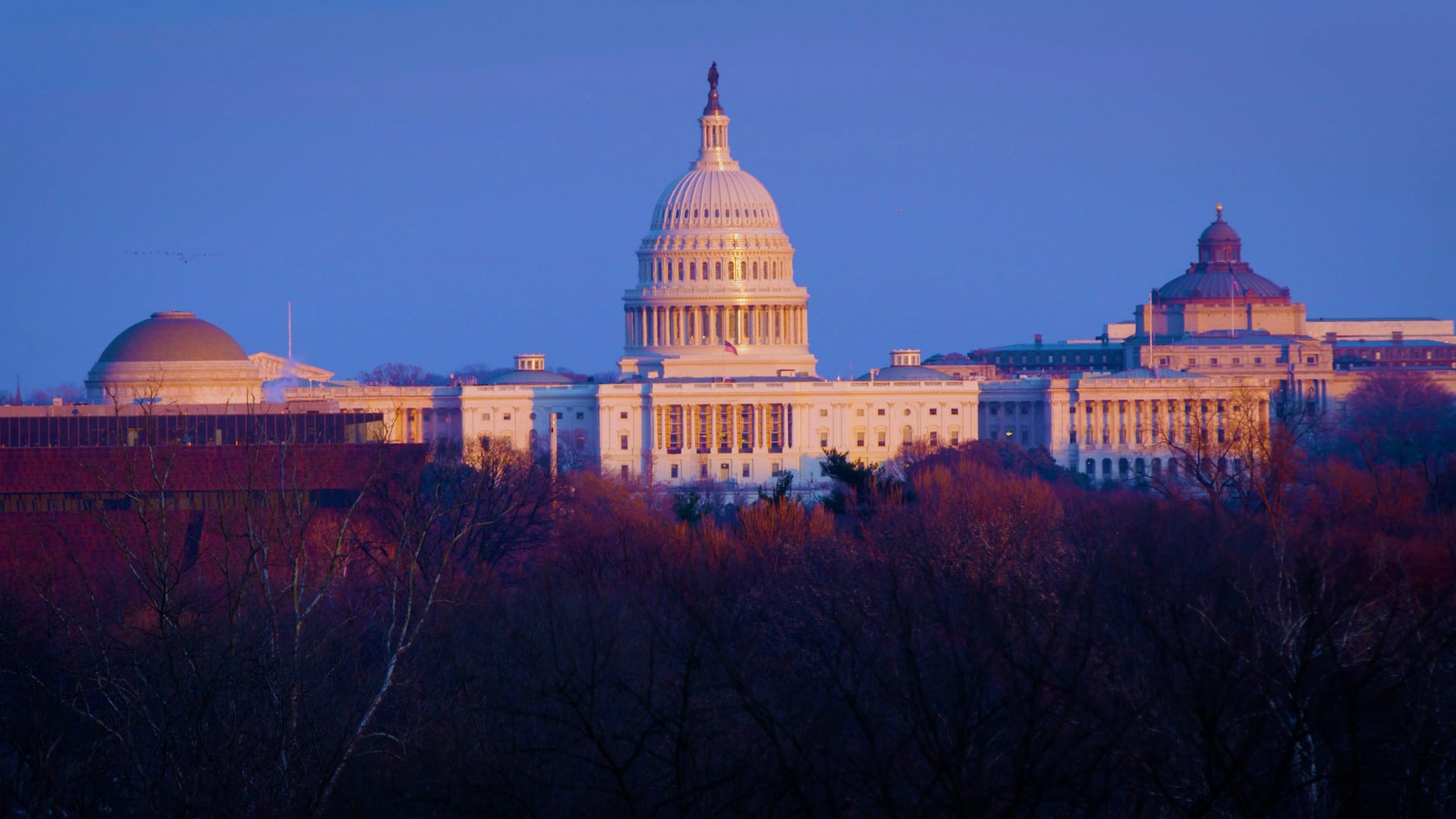

Government shutdown begins after Congressional leaders disagree
About 750,000 federal employees, from national park workers to financial regulators, could be on the air every day during the shutdown.
- Mark Zandi, chief economist at Moody Analysis; If the federal government shutdown lasts just one to two weeks, the impact on the economy and financial markets will be limited, he said.
- Many federal employees will not be paid during the shutdown, and household budgets will be squeezed. U.S. Senate Federal Credit Union offers Federal Shutdown Relief Loans.
How much economic disruption could a federal government shutdown cause?
We’ll know soon if the shutdown, which began at 12:01 a.m. on Wednesday, October 1, will drag beyond a few more days. It’s all about the period and the kinks that are already in place.
Wall Street opened relatively calmly on Wednesday, about 9 1/2 hours into the shutdown. The Dow Jones Industrial Average was trading at 46,356.25 points as of 9:31 a.m. Oct. 1, down 41.64 points or 0.09%.
By 9:40 a.m., the Dow was trading 34.73 points, or 0.07%, at 46,432.62 points. But the Dow lost ground before 10 a.m. and came back again
The Dow rose 88.82 points or 0.19% to trade at 46,486.71 points just before 3:30 p.m. Oct. 1 – 30 minutes before the market closed at 4 p.m.
The Dow closed at 46,441.10 points, up 43.21 points or 0.09%.
“If the shutdown lasts a week or two, we don’t think it will have a material impact on the economy and financial markets,” said Mark Zandi, chief economist for Moody’s analysis.
That assumes the Trump administration does not end up laying off government workers during the shutdown, as officials have said. Analysts worry that the economic impact will be much deeper if more people are laid off.
How painful will the shutdown be in the next few days?
If a budget resolution is not reached soon – and the shutdown lasts a month or two, we are talking about a completely different outlook.
“The heightened uncertainty and concerns about the country’s governance and safe haven status will be difficult for equity and fixed income investors to ignore,” Zandi said.
Wall Street and Main Street don’t tend to do well with uncertainty for long.
Still, haven’t we been here before? And we were fine, right? But is the U.S. economy more fragile than during previous shutdowns because some consumers are better off?
On the other hand, we face the possibility of government shutdowns quite often in our lifetimes. For example, a shutdown was narrowly avoided in 2023 hours before the September 30 deadline.
But you have to go back nearly seven years to the last time Congress was unable to reach a deal, and we entered a period of similar uncertainty.
This year’s shutdown seemed inevitable as the White House runs a “Government Shutdown Clock” online, adding up the hours, minutes, and seconds of a 2025 shutdown. President Donald Trump’s White House website carries a flag that says, “Democrats have shut down the government.”
The federal government’s most recent (and longest) shutdown hit on December 22, 2018, and lasted until January 25, 2019.
For a long time, yes, but the economy and stock market were fine after being shut down during the first Trump administration seven years ago. The last federal shutdown was considered a “partial” shutdown because Congress had already enacted a handful of spending laws.
A government shutdown occurs when Congress is unable to pass spending legislation, but not all federal services are shut down.
How did stocks perform during the 2018-19 shutdown?
The last go-round didn’t cause panic on Wall Street.
According to CFRA Research data, the Standard & Poor’s 500 index fell 7.1% in the week before the 2018-19 shutdown began. The S&P 500 index fell 2.7% on the first day of the shutdown, which dragged on for 35 days. The S&P 500 rose 10.3% throughout the long shutdown. The index rose another 4.8% 30 days after the shutdown ended.
“Most of Wall Street is cynical about the impact of the government shutdown,” said Sam Stovall, chief research investment strategist at CFRA.
Stovall says he likes to think of government shutdowns as “more of a headline event than a bottom-line event.”
While the news is certainly worth watching, the financial impact on retirement savings and other investments tends to be limited, he said.
The shutdown began on Wednesday. However, Stovall noted that 12 of the last 21 shutdowns occurred on the weekend, Friday, Saturday or Sunday. The 11 closures since 1984 lasted a median of only four days, Stovall said.
Weekend tourists in New York tend to face more challenges than Wall Street traders dealing with the Monday-through-Friday grind, he said. After all, an extended shutdown could lead to flight delays and longer waits at airports.
There tended to be much less financial fallout early after the shutdown, as Wall Street traders became accustomed to government shutdowns, Stovall said.
“No one knows how Wall Street will react this time, but I don’t think it will be any different than in the past,” Stovall says.
Investors are more focused on the monthly jobs report, scheduled to be released Oct. 3, and whether the Fed will cut fees in October and December, he said. The Fed’s next meetings are October 28th and October 29th, and Trump is actively lobbying for the Fed to cut short-term interest rates again.
If the government remains shut down, no employment reports will be published as the U.S. Department of Labor delays the release of economic data, Stovall said.
In that case, Wall Street traders will consider other data available, such as recently published jobs and labor turnover surveys that have been published slightly less than expected, and weaker-than-expected consumer confidence reports.
Everyday households will focus on other issues such as: How much money could you lose if the shutdown lasts into November or December?
Some things will continue as usual. Social Security payments are expected to arrive on time. Military personnel, air traffic controllers, and other essential personnel are required to work, but may not be paid on time.
Hundreds of thousands of federal workers will be hit without pay. Many will not be paid during the shutdown, and household budgets will be squeezed.
For example, the U.S. Senate Federal Credit Union is offering federal shutdown relief loans of up to $5,000 with no payments for 90 days. The credit union saw it offer a similar type of loan relief to striking UAW workers at three automakers in Detroit in 2023.
Fortunately, many federal employees hurt by the shutdown will later be paid under a 2019 law that mandates retroactive automatic pay once the shutdown ends, according to details in “Shutdown Guidance” issued by the U.S. Office of Personnel Management in September. The safety net does not apply to everyone. Government contractors, unlike direct federal employees, typically do not receive reimbursement after a shutdown.
Shutdowns hit when Dow is breaking records
Overall, the economy is progressing. The stock market has clearly soared to new heights, giving wealthy households more room to maintain spending.
I’ve seen record rallies. The Dow Jones Industrial Average broke yet another record on September 30th as the shutdown deadline approached, closing at 46,397.89 points.
Still, concerns are building about a potentially precarious job picture given that the full impact of the tariffs has yet to be felt. Higher tariffs would put pressure on profit margins and could lead to higher prices for many goods and job losses in some industries.
Consumers increasingly believe that labor market conditions will weaken, according to a University of Michigan consumer survey. About 65% of consumers expect the unemployment rate to increase, up from 57% in July 2025 and 35% a year ago, according to a survey released on September 26th.
In the September survey, the UM Consumer Sentiment Index fell to 55.1, down from 58.2 in August and below 70.3 last September.
Matthew Nestler, senior economist at KPMG Economics, said in a report that the number of job openings increased to 7.2 million jobs available nationwide in August.
Among various sectors, he said the federal government posted the lowest number of jobs (about 77,000) since February 2018.
“Despite new hiring plans for Customs and Border Protection, government job openings have fallen off a cliff since the beginning of this year,” he wrote in a Sept. 30 report.
Unemployment remains low, but expectations are for slow economic growth.
“The demand for labor is decreasing while the demand for labor is decreasing due to reduced immigration and increased retirement,” Nessler wrote.
He noted that lower levels of shootings continue to offset lower employment.
“Employers are likely hoarding labor due to supply-side shortages due to changes in immigration policy,” Nessler wrote on Sept. 30.
A lengthy government shutdown will only complicate the employment picture and likely further erode consumer confidence. This is a reality that could give Congress more reason to resolve the issue before 35 days.
Contact personal finance columnist Susan Tompol: stompor@freepress.com. follow himr x @tompor.


